
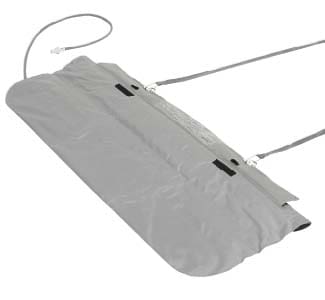
Mangar Leglifter with Airflo 12
Lifting legs into bed can often prove difficult. Our inflatable Mangar Leglifter provides valuable assistance with lifting legs into bed using single handed care techniques. The Leglifter is attached to the bed underneath the mattress. It is straightforward to fit or remove and requires no permanent installation. When not in use the Leglifter sits discreetly against the side of the bed.
Product Details
- Enables user to lift legs into bed independently
- Fits most beds, including profiling beds
- Portable and lightweight
- Minimises moving and handling risks
- Battery powered
- Max user weight 300lbs
- Inflated length 49″
- Inflated width 22″
- Inflated thickness 4″
- Weight of product 2.6lbs
The use of this product reduces the moving and handling risks to the caregiver, including musculoskeletal conditions.
Frequently Asked Questions
Administrators should choose equipment that works for caregivers, not equipment that makes caregivers work harder. While purchase price is important, factors such as ease of use, resident outcomes, staff satisfaction, durability, maintenance requirements, training needs, and total cost of ownership often have a greater long-term impact. The best equipment investments support both quality care and a positive caregiver experience.
Equipment that helps reduce caregiver injuries includes patient lifts, repositioning devices, integrated bed systems, therapeutic support surfaces, and mobility equipment. Bed systems are especially important because they support both resident and caregiver safety through multiple height positions. Low height (approximately 7 inches) can help reduce fall-related injuries, egress height (approximately 18 inches) supports safer bed exits and transfers, and care height (approximately 35 inches) helps reduce caregiver strain. Adjustable equipment that supports safe patient handling and mobility can help create a safer care environment for both residents and caregivers.
The leading predictors of falls in nursing homes are a history of previous falls and changes in environment, including new admissions and transfers. Many falls occur within the first 48 hours of entering a new care setting, when residents are adapting to unfamiliar surroundings and may have reduced mobility or functional abilities. Effective fall prevention combines resident assessment, mobility support, appropriate bed systems, monitoring technologies, and caregiver education.
Evidence-based falls management uses clinical research, risk assessment, monitoring technology, therapeutic surfaces, appropriate bed heights, and proven care protocols to reduce fall risk and injury severity while maintaining resident dignity and mobility.
Best practices include individualized risk assessments, proper bed selection, low-height bed use, bed-exit monitoring, caregiver training, environmental safety measures, mobility support, safe transfer protocols, and routine review of fall incidents to guide continuous improvement. [joerns.com], [joerns.com]
An effective falls prevention program combines resident risk assessment, staff education, mobility support, safe patient handling practices, low-height bed systems, therapeutic support surfaces, monitoring technologies, and ongoing outcome evaluation. Facilities should consider not only a bed’s low height, but also its ability to support safe egress height for residents and appropriate care height for caregivers. A multidisciplinary approach helps reduce both fall frequency and injury severity while supporting resident mobility and caregiver safety.
Facilities can improve resident safety by integrating fall prevention, pressure injury prevention, safe patient handling and mobility programs, advanced support surfaces, staff education, and monitoring technologies into everyday care workflows.
Post-acute care facilities can improve staff efficiency through equipment standardization, streamlined workflows, integrated bed systems, resident monitoring technologies, safe patient handling equipment, and mobility solutions. Standardization helps caregivers work more consistently, reduces training requirements, simplifies maintenance, and improves equipment utilization. When paired with intuitive technology and efficient processes, these strategies help caregivers spend more time focused on resident care.
Repositioning frequency should be individualized based on resident risk, mobility status, skin condition, and clinical protocols. Advanced support surfaces can help redistribute pressure and reduce tissue loading between repositioning events, supporting a comprehensive pressure injury prevention strategy.
We recommend utilizing our online resources prior to use and reading the manual, if more training is needed, reach out to your local rep and we can provide virtual assistance or an on-site in-service.
Mobility level, weight, and the number of assists needed all factor in. A full-body sling lift suits residents with no weight-bearing ability, while a sit-to-stand lift works for residents who can bear some weight. Our clinical team can walk through your facility’s resident mix with you.
Our lifts range from a safe working load of 340-850 lbs. Exact capacity is listed on each product’s spec sheet.
Patient lifts should be used when a resident cannot safely transfer independently or when manual assistance creates a risk of injury to the caregiver or resident. Lift systems can support transfers from bed to chair, chair to toilet, and many other mobility activities while improving safety and preserving dignity.
Mobility programs help residents maintain strength, function, and independence. Because a resident’s level of acuity is often closely linked to mobility, preserving or improving mobility can help residents remain in their current care setting, reduce complications associated with immobility, and support discharge goals. Effective mobility programs contribute to better clinical outcomes, improved quality of life, and greater independence.
Technologies that support care quality include smart bed systems, integrated support surfaces, bed-exit monitoring, nurse call connectivity, pressure redistribution therapies, fluid immersion simulation technology, and safe patient handling and mobility solutions.
Healthcare facilities can reduce pressure injury rates through proactive risk assessment, integrated bed and support surface systems, pressure management technologies, staff education, moisture management, and early intervention. Repositioning and mobility programs are especially important because they help reduce prolonged tissue loading, support circulation, and address the risks associated with immobility. A comprehensive prevention strategy combines technology, clinical protocols, and resident mobility to support skin integrity and wound prevention.