
Improving performance under MA is not about doing more work. It is about doing better connected work across time, across settings, and across disciplines. The organizations that embrace that shift move from being seen as utilization risks to being seen as utilization solutions. And in today’s post-acute landscape, that distinction can shape everything.
Medicare Advantage Post-Acute Care Is No Longer the Exception
If you lead in post-acute care today, here’s the reality: Medicare Advantage (MA) is no longer a trend to watch. It is the environment you are operating in.
For years, many organizations treated Medicare Advantage post-acute care as a secondary challenge, something to manage around while the fee-for-service model still shaped the core business. That mindset no longer holds. More than half of eligible Medicare beneficiaries are now enrolled in MA, and in 2026, that share is expected to reach 55%, making MA the dominant form of Medicare coverage in the market.
That matters because MA does not simply change who pays the claim. It changes the entire logic of how care is evaluated, how length of stay is justified, how transitions are managed, and how value is judged across the patient’s journey.
What Medicare Advantage Skilled Nursing Really Requires From Leaders
Too many facilities are still structured—operationally and culturally—for a fee-for-service world. And that mismatch is exactly why MA feels so difficult for so many providers.
When leaders describe MA pain points, they usually talk about denials, shortened stays, prior authorization, or tighter utilization review. Those pressures are real. But in my view, they are not the root problem.
The deeper issue is that MA requires providers to think in episodes, not days; in journeys, not silos; and in demonstrated value, not assumed medical necessity.
Once you see MA through that lens, the strategy changes. The question is no longer, “How do we survive Medicare Advantage?” It becomes, “How do we build a system that performs well inside a managed episode of care?” That is a very different leadership question—and a much more productive one.
Medicare Advantage Manages the Entire Episode—Not Just the Stay
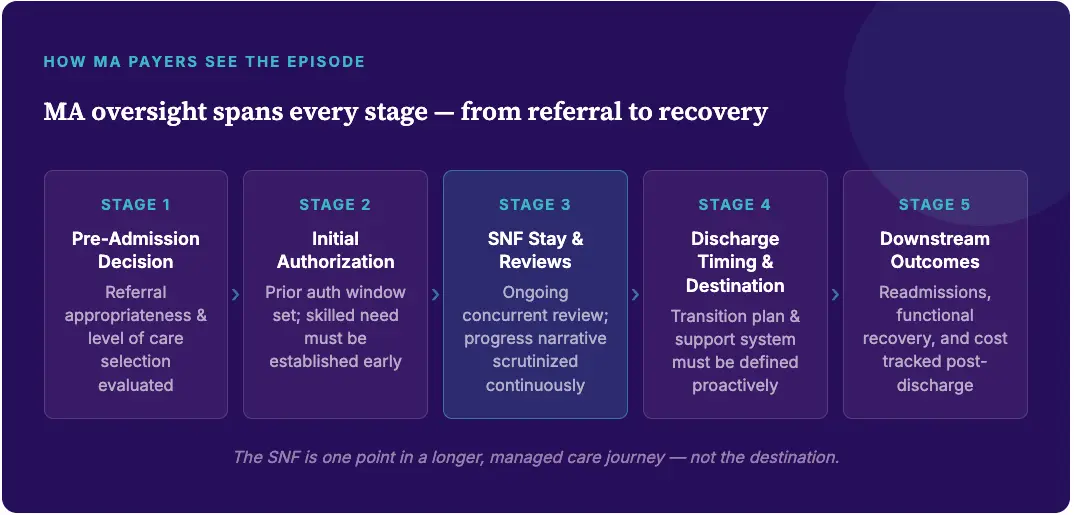
Under traditional Medicare, success was often judged within the four walls of the building. Stabilize the patient. Deliver the skilled service. Document correctly. Get paid.
MA replaces that with a fundamentally different model. MA plans are not just about evaluating what happens during the SNF stay. They are managing the pre-admission decision, the initial authorization window, the ongoing reviews, the discharge timing, the discharge destination, and increasingly the downstream outcomes that follow. That broader level of oversight is closely tied to widespread prior authorization use in MA, including for post-acute care and skilled nursing stays.
Key Mindset Shift: From the payer’s perspective, the SNF is not the destination. It is simply one point in a longer, managed care journey. That means providers who focus only on what is happening inside the facility are often missing the bigger strategic picture.
Where did the patient come from? Why was this level of care chosen? What functional outcome is being pursued? What is the next transition, and how soon is it expected? Under MA, those are not background questions. They are core business questions.
“The deeper issue is that MA requires providers to shift from day-counting to journey-mapping. Success is measured in demonstrated value and entire episodes of care, not individual silos of service.”
Why Medicare Advantage Feels Harder Than Fee-for-Service
Many providers experience MA as more restrictive, more bureaucratic, and more adversarial. Sometimes that is true. But just as often, what feels like friction is really a response to uncertainty in the episode of care.
1. Early Vagueness
MA plans want an early, coherent story about skilled need, functional trajectory, anticipated length of stay, and discharge readiness. When that story is weak or delayed, the plan limits risk through shorter approvals, faster reviews, and tighter scrutiny.
2. Fragmented Documentation
MA does not reward disconnected notes from separate disciplines. It looks for a coherent narrative. When nursing, therapy, and medical documentation are not aligned around shared goals and measurable progress, the payer does not see complexity—it sees inconsistency.
3. Weak Transition Planning
From the MA perspective, unclear discharge planning creates downstream costs and risk. If the next step in care is not well defined, or the support system is not in place, plans intervene earlier and more aggressively. MA friction often reflects uncertainty in the journey—not a lack of effort from the care team.
From Care Delivery to Journey Management
This is where the mindset shift matters most. High-performing providers do not just deliver care under MA. They manage the episode alongside the payer.
That means moving from retrospective justification to real-time narrative building; from setting-based thinking to episode-based thinking; from departmental goals to shared functional outcomes; and from discharge as an endpoint to discharge as a transition.
In practice, that looks like earlier alignment on the patient’s functional baseline and goals, stronger interdisciplinary documentation, proactive communication that answers payer questions before they are asked, and technology that helps turn daily care activity into credible outcomes-based evidence. The organizations that do this well stop reacting to MA plans and start participating productively with them.
The Opportunity Hidden Inside the Pressure
Here is the part many leaders miss: MA does not just restrict revenue. It redistributes opportunities toward providers who can manage care well across the full episode.
Providers that reduce avoidable transitions, prevent readmissions, move patients through the right level of care at the right time, and produce predictable functional outcomes become more valuable—not less—in an MA-dominant environment. Emerging research has also shown that MA beneficiaries often use fewer post-acute care days without worse outcomes, and in some analyses, they experienced lower readmission rates and similar or better recovery patterns than traditional Medicare beneficiaries.
That does not mean the model is easy. It means the winners are different. In a majority-MA world, clinical credibility, operational discipline, and transition management become competitive advantages. The providers that can demonstrate those capabilities consistently are the ones most likely to build trust with plans, strengthen referrals, and create more stable revenue over time.
So, What Should Leaders Do Now?
If your census is increasingly MA—and for most providers, it is—then the leadership challenge is not to work harder inside the old model. It is to redesign your operations around the current one.
I think leaders should be asking three practical questions right now:
- Do we truly understand the full episode of care, or only our part of it?
Next Step for Leaders:
Turn Clinical Infrastructure Into a Managed Care Advantage
Managing the journey requires more than a cultural shift—it requires physical infrastructure built for outcomes. To see how clinical equipment investments translate directly into protected operating margins and 5-Star performance under this managed care reality, read our comprehensive financial brief.